Traffic-Men
Site: Nørrebroparken, Copenhagen, DK
Year: 2023
Status: Temporary public artwork
Collaborators: Nørrebroparken users
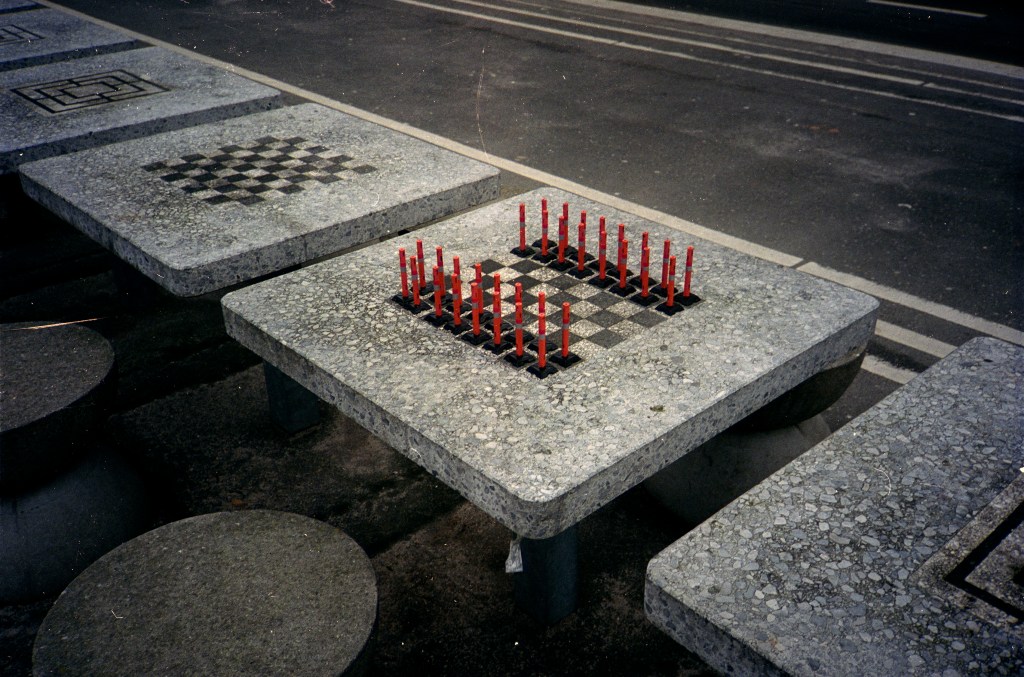
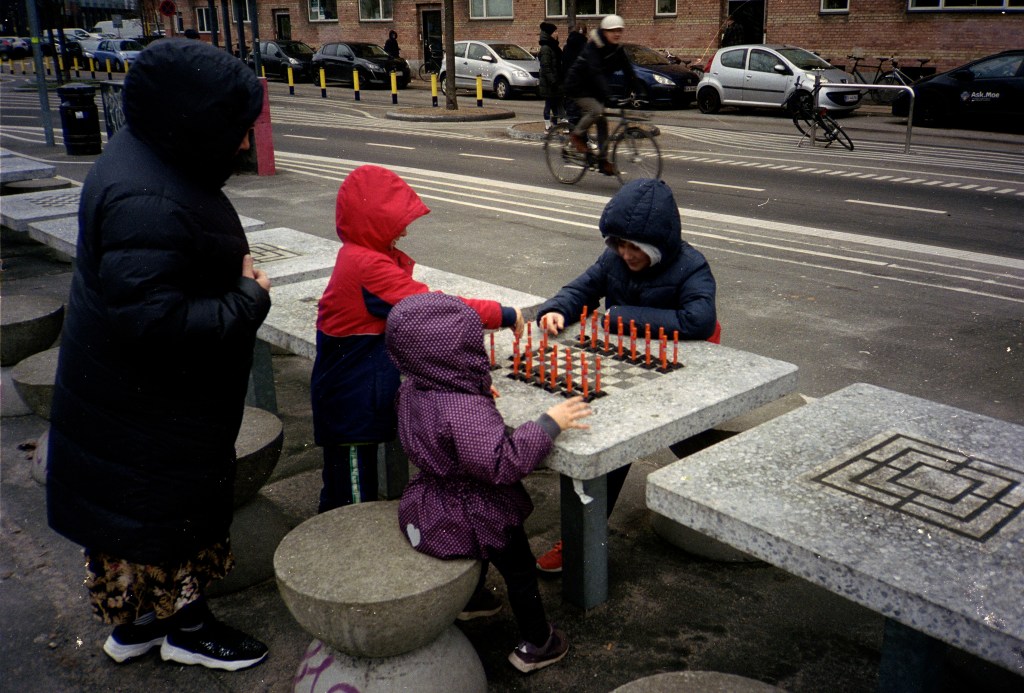
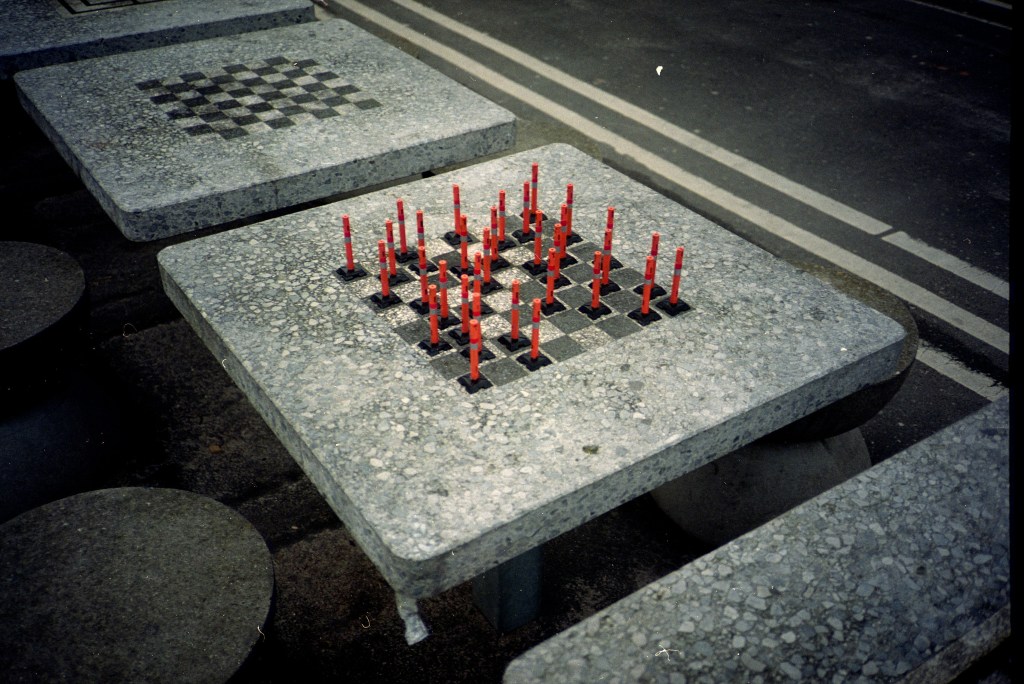
This intervention, featuring 32 miniature traffic posts placed on a public chessboard, conceptualises the chessboard as a microcosm of the city. It invites public participation and contemplation on the role of urban objects in shaping the functionality, aesthetics, and social dynamics of urban spaces.
The visual dichotomies of the chessboard mirror those of the Nollimap, a cartographic typology that delineates public from private space. In this analogy, white signifies public spaces, while black represents private spaces. The black-and-white interplay on the Nolli map emphasizes the importance of public space by vividly distinguishing it from private space, demonstrating its connectivity and central role in urban life.
The addition of traffic posts disrupts the spatial order of public spaces, transforming the openness and accessibility into closed and inaccessible. Resulting in the transformation of sociopetal spaces, designed to foster interaction, into sociofugal spaces that repel interaction. Through a Foucauldian lens, these seemingly trivial urban objects metamorphose into symbols of spatial manipulation, restriction, and control.
This intervention subverts the conventional power dynamics of the traffic post, fostering social interaction instead of discouraging it, by inviting the public to collectively dictate the movement of the traffic posts, rather than vice versa. From a cartographic perspective, the playful, perpetual reshuffling of the traffic posts reflects the spatial impact of the urban object by obscuring the white, open spaces with the black bases of the traffic posts. This not only highlights the influence of these seemingly mundane objects but also invites critical reflection on the power structures embedded within our urban landscapes.

 conor k. coughlan